Sustainability
Return-related emissions are a substantial part of fashion's environmental footprint. The reduction levers are: cut return volume, route returns more efficiently when they happen, minimise packaging waste, and report what is actually measurable rather than what sounds impressive.

Pepijn Stribos
Co-founder, It Goes Forward · 12 min lezen · Laatst bijgewerkt:
Vertaling volgt. We tonen de Engelse versie.
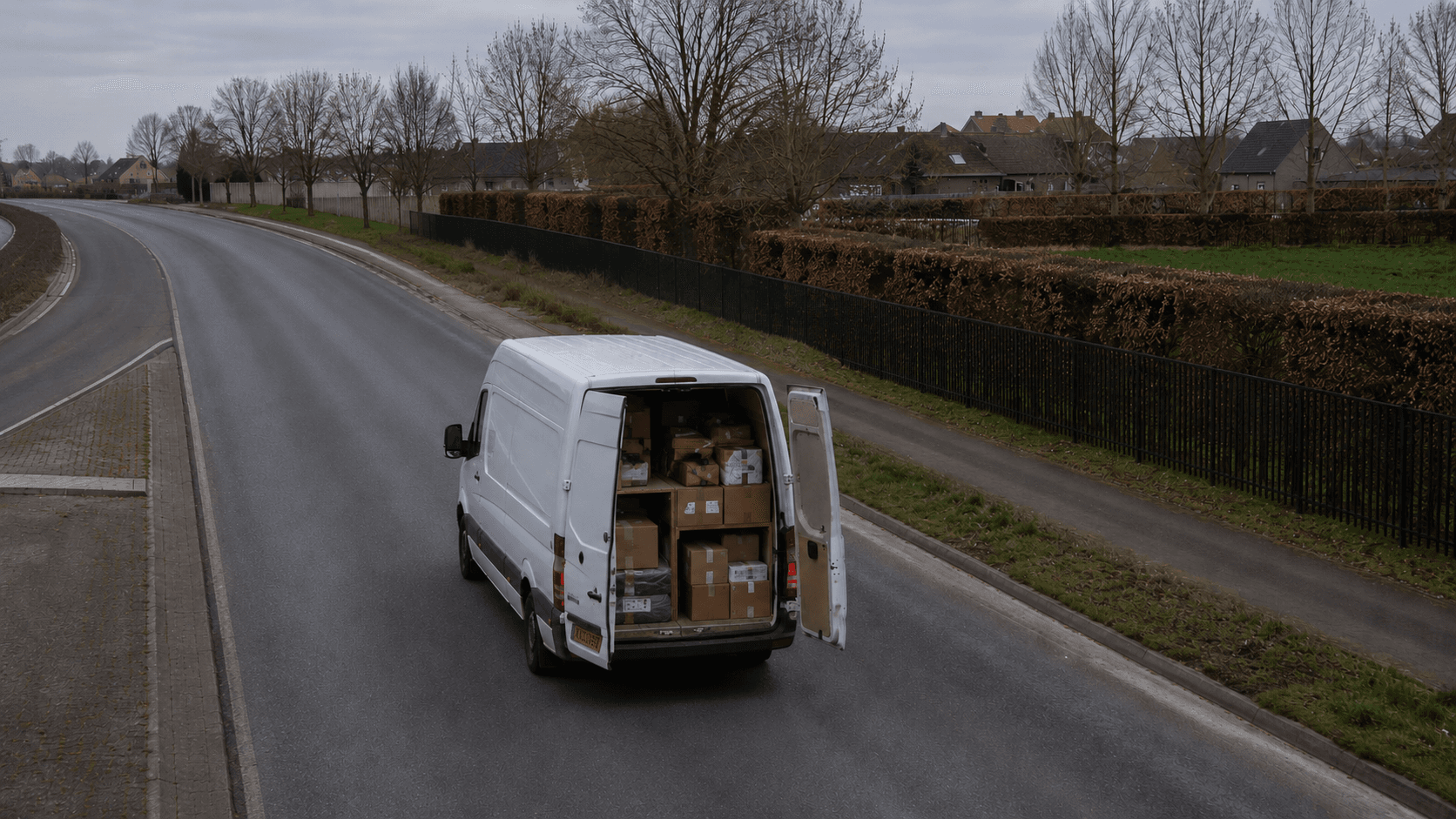
Returns generate emissions. The original delivery already accounts for some, then the return adds another shipment, then the warehouse processes the item, sometimes the item ships out again to a new buyer, and a meaningful share are written off and disposed of. Each of these steps has an emissions footprint that is increasingly being measured and, under European reporting standards, increasingly being disclosed.
Industry estimates put the global figure at around 24 million tonnes of CO₂ per year from e-commerce returns alone (Optoro, 2022). Per individual return, the typical added emissions are around 30% on top of the original delivery footprint (CleanHub). For a fashion retailer with a 30% to 40% return rate, return-related emissions are not a rounding error in the carbon ledger.
This article covers the main levers fashion retailers can pull to reduce return-related emissions, what is honestly measurable versus estimated, and how to report return emissions credibly under CSRD and adjacent disclosure regimes. It is written for sustainability officers, ESG leads, and brand managers who need to make decisions that will hold up under audit.
The footprint of a single return decomposes into roughly five categories.
The return shipment itself. The customer ships the item back to a warehouse. For domestic European returns, this is typically a few kilograms of CO₂ per parcel, depending on distance, mode (last-mile electric is lower than diesel van), and consolidation. Cross-border returns multiply this significantly.
Warehouse handling. Receiving, inspection, photography (where required), repackaging, and put-away. Electricity for lighting and climate control, plus a share of the building's embodied carbon, allocated per item. Smaller per item than transport but cumulative across the operation.
The second outbound shipment. When the return is resold and ships to the next customer, that shipment is effectively another delivery the retailer pays for in emissions. For items sold at the same price, this is logistical overhead with no additional revenue.
Packaging. New mailers, dunnage, labels. The manufacture of single-use packaging is itself an emissions cost, and so is its disposal at the end-customer's home. Modest per item, but at scale, meaningful and increasingly accounted for under PPWR.
Disposal of write-offs. The roughly 18% of returned fashion items written off entirely (industry research, including Ben-Gurion University) end up incinerated, landfilled, or sometimes exported. Each pathway has emissions. Disposal-related emissions are often the largest unaccounted-for category.
For any retailer running a meaningful sustainability programme, the question is which of these to attack first. The answer depends on operational shape, but the order is usually: volume, routing, packaging, disposal.
The most efficient return is the one that does not happen. Every percentage point off the return rate reduces all five emissions categories proportionally, with no operational reconfiguration needed.
The practical levers for return reduction (better sizing data, accurate photography and descriptions, surfacing fit reviews, sensible return policies, identifying serial abusers) are covered in detail in our practical guide to reducing online returns. The point worth making here is the leverage. A retailer cutting return rate from 40% to 30%, even before any routing optimisation, reduces total return-related emissions by roughly 25%. That is a quarter of the impact achieved purely through upstream improvements.
Volume reduction also tends to be cheaper to deliver than routing reconfiguration. Better product photography, clearer size charts, and tighter return policies are operational improvements that pay back through cost reduction as well as emissions reduction. The ROI of sustainability spend is rarely as good as it is here.
The limit is structural: customers buy fashion online with the option to return, and that option drives volume. Below 25%, return rates rarely fall sustainably. Beyond a point, the marginal investment in reduction stops returning, and the emissions question shifts from "how do we have fewer returns" to "how do we handle the returns we will keep having more efficiently".
A conventional return goes from the customer back to a central warehouse, gets inspected and repackaged, and ships out again to the next buyer. That is two cross-country shipments per return event, often through national or regional fulfilment hubs that may be hundreds of kilometres away from both the customer who returned and the customer who buys next.
A more recent approach is peer-to-peer return forwarding: the algorithm matches an incoming return with an outgoing order for the same product, and the item ships directly from the returning customer to the next customer, skipping the warehouse entirely. The first cross-country shipment becomes the only shipment.
The per-Forward emissions saving in production deployments runs roughly 250 to 400 grams of CO₂, depending on geography, distances, and the carrier mix. The methodology was independently validated and published in Omega 128 (Elsevier, 2024). Several companies are building in this category, including It Goes Forward, where the approach is in production at fashion retailers including Kuyichi.
Peer-to-peer routing is not universally applicable. It works best where return volume is high enough for matching to find buyers reliably, where items are in resaleable condition (the warehouse is not adding value through inspection beyond what the buyer's rating can verify), and where the consumer base is comfortable with direct-from-consumer shipping. For deeper coverage of where the model fits and where it does not, see our explainer on peer-to-peer returns.
For retailers where peer-to-peer fits, the emissions reduction is meaningful and accountable per-transaction. For retailers where it does not, routing reductions still come from consolidating return shipments, returning to closer regional hubs, and minimising re-shipping distance to the next buyer.
Return packaging is often overlooked in emissions analysis because the per-parcel quantity is small. The cumulative effect across the year is not. A retailer handling 100,000 returns annually is putting 100,000 mailers through the manufacture-use-dispose cycle, plus dunnage, plus labels.
The Packaging and Packaging Waste Regulation (PPWR), entering force in August 2026, makes packaging waste an accountable part of the cost structure. Mandatory recyclability standards, restrictions on certain disposable formats, and a 50% empty-space cap on e-commerce packaging by 2030 push retailers toward different choices.
For returns specifically, the practical adaptations are: reusable mailers (used for both outbound and return), label-free returns where the courier prints labels in store, and flat-pack designs that reduce dunnage. Each of these reduces packaging emissions and PPWR exposure simultaneously. For full coverage of PPWR alongside the rest of the regulatory framework, see our comprehensive guide to EU sustainability regulations for fashion retailers.
The difference between measured and estimated emissions matters increasingly under European reporting standards. "24 million tonnes globally per year" is an industry estimate based on aggregate volume and average shipping emissions. It is useful for context. It is not what an individual retailer can disclose under CSRD.
What retailers can measure with reasonable accuracy:
What retailers typically estimate:
What retailers should not claim:
The credible position is per-transaction measurement against ISO standards, with a clear distinction between measured, estimated, and excluded categories. Several emerging tools (carrier-integrated calculators, return-specific measurement platforms) make this technically feasible at retailer scale. It Goes Forward is one of several providers offering per-transaction CO₂ reporting for retailers using peer-to-peer routing; comparable tools exist for warehouse-routed returns.
The Corporate Sustainability Reporting Directive (CSRD), now in force for the largest cohort of European companies and phasing in for smaller cohorts through 2028, requires standardised disclosure of climate impacts following European Sustainability Reporting Standards (ESRS).
Returns sit primarily in ESRS E1 (climate change) under Scope 3 emissions, specifically downstream transportation and distribution (Category 9) and end-of-life treatment of sold products (Category 12). The disclosure expectation includes:
For return-specific disclosure that holds up under audit:
Auditors are increasingly questioning offset-heavy claims and unverified "carbon-neutral" labels. The position that holds up is conservative reporting backed by per-transaction data, with reductions disclosed on an absolute basis ("return-related emissions reduced by 18% year-over-year") rather than relative to offset purchases.
For the broader regulatory context including ESPR, ECD, and EPR and how they interact with CSRD, see our comprehensive guide to EU sustainability regulations for fashion retailers.
The sustainability function in fashion retail has moved from voluntary brand positioning to mandatory disclosure under regulatory frameworks that get sharper every year. Returns are a meaningful part of that picture, and the operational decisions made about them now will shape what gets reported for years.
Estimates vary by distance, carrier, and item type, but research consistently finds transportation accounts for over 90% of the carbon footprint of apparel returns (Long and Liu, 2025). A domestic return in Europe generates roughly 0.3 to 1 kg CO₂ per shipment; cross-border returns are significantly higher.
Reducing return volume is the most impactful lever: fewer returns means fewer shipments. Where returns happen, routing efficiency matters most. Peer-to-peer return forwarding eliminates one shipment leg entirely (the return trip to the warehouse) and typically saves around 310g CO₂ per Forward versus conventional warehouse routing.
Return logistics fall under Scope 3, category 12 (end-of-life treatment of sold products) and potentially category 9 (downstream transportation). Retailers need a documented, reproducible methodology for calculating emissions per return type. Per-transaction CO₂ data from carrier integrations and routing providers is the most defensible approach under ESRS E1.
European Environment Agency research (2024) found that roughly one in three garments bought online ends up destroyed. Ben-Gurion University research cited in industry benchmarks places write-off rates at around 18%. Items destroyed contribute embodied emissions without generating any further use value.
Na het lezen
Our ISO-standard per-Forward CO₂ methodology is the same data we'd give your CSRD reporting team. If that's helpful, we can walk through it on a 30-minute call. No pitch: just the data and the methodology.

CSRD, PPWR, ECD, ESPR, EPR: five EU regulations transforming fashion retail in 2026. What each requires, the deadlines, and how retailers can prepare across the full compliance map.
Laatst bijgewerkt:

An emerging return model routes returns directly from one customer to the next without warehouse processing. This article explains the mechanism, where it fits, where it does not, and how to evaluate it as one option among several.
Laatst bijgewerkt:
